
The Shape of What Remains » Entries
December 5, 2025
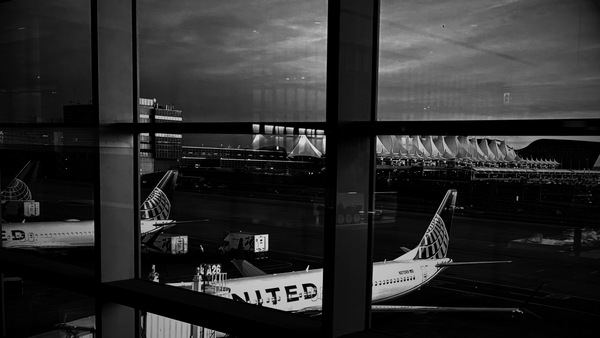
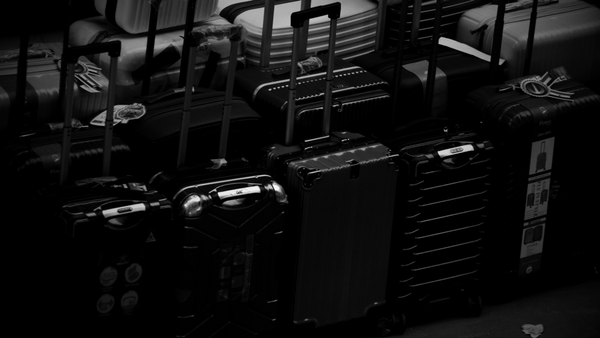
There is a red bandana folded on my desk. I use it as a napkin now—an object demoted from significance to utility, though it was never meant for coffee stains. For thirty years it has been with me, a Western-wear square purchased at an LAX gift shop during a layover sometime in 1989 or '90. I bought it because I needed a way to mark my suitcase, to distinguish it from the carousel of identical luggage circling endlessly beneath the fluorescent hum of baggage claim.
My father had given me his old grey Samsonite—a hand-me-down from early '70s, generic as any other clamshell rectangle wandering through the world. The bandana made it mine. I tied it to the handle, a red flag announcing: This one belongs to Dean.
The red bandana traveled with me for two decades. Seoul. Hong Kong. Osaka. Toronto. Seattle. Through customs and security checkpoints, across continents and time zones, it marked my passage. The suitcase eventually broke after a return trip from Japan during my university years. I kept the bandana. By the 2010s, when my international travel began to slow, I removed it from circulation and placed it here, on my desk, where it has remained ever since.
I look at it and wonder, is it ready for one more trip next week? Am I ready? At fifty-five, how many more trips do I have in me? Will it outlive me, this red cotton square that knows more airports than I can remember?
I remember only fragments of those years. It remembers everything.

Edward Said wrote that exile is
...the unhealable rift forced between a human being and a native place, between the self and its true home. 1
But for those of us born into margins—what Homi Bhabha calls the "third space"—there is no native place to be severed from. The third space, Bhabha argues, is not a space of belonging but a space of becoming—where hybrid identities resist reduction to any origin.
I have spent my life as what I call an emergent phenomenon: Not Japanese enough for Japan. Not American enough for America. I am an amalgamation—a hybrid identity that exists in the gap between categories. An affront to the terms and conditions of both, while possessing the comforts and privileges of neither.
The red bandana is evidence of this refusal. A mark of resistance—not failure. Bhabha argues that hybrid identities are not deficiencies but sites where new meanings emerge. This happens precisely because one is not trapped in subjective, essentialist categories. The third space, he writes, is where "something else" appears—something that contains qualities of two territories, yet cannot be reduced to either.
This is what I carry. Not confusion, but a vast, rich multiplicity. Not failure, but the burden of always having to announce myself. To say continuously, in some form or fashion, I am of you, but not one of you.
But it is exhausting.
I long to be like you—one of you. To land somewhere and simply be, without the red flag silently announcing my perpetual otherness. Without having to justify my presence. Without having to explain who I am, how I came to be, and why I exist.
I long to set down my bag and have it recognized as one of many without explanation. To embrace your myth of skin, soul, and passport as one. To be seen so naturally that no marker is needed. No translation required. No explanation necessary. To just be me.
But that is not my inheritance. And that is not my fate.
My father gave me that grey old Samsonite when I was nineteen, leaving for university in Japan. I tied a red bandana to its handle and learned to call displacement home. The bandana knows this. It remembers customs officers in two continents, the humidity of Busan, the cold steel under the floors of New Chitose Airport. It remembers versions of me that moved with purpose through those spaces—younger, more hopeful, convinced that motion itself was a form of belonging. That if I kept moving, I would eventually reach a place that felt like mine. Like home.
I never did.
And now the bandana sits on my desk, folded beside my coffee cup, seemingly inert as I. Two nomads of time and space, still in perpetual motion—albeit slower than before. But next week I am traveling again, and I wonder, should I bring it? Should I tie it once more to my suitcase handle and let it announce, one more time, that I am here—even if no place is mine?
Roland Barthes wrote in Camera Lucida that photographs carry "that-has-been"—the spectral proof that something existed, even if only for a moment. The red bandana is the same. It is evidence that I existed in those airports, those cities, those years, those lives. That I moved through the world and left no trace except this small piece of patterned cloth, which remembers everything I have forgotten.
This is what remains. Evidence instead of certainty. Persistence instead of belonging. The red cloth that says, This is mine.
At fifty-five, I am no longer sure how many trips still await me. But the bandana is ready. It has always been ready. It will outlive me, I should think, long after I am gone. Some future stranger will find it folded among my things and wonder what it tagged, what it meant, or why I kept it for so long.
They will never know it was a small shred of proof that I existed.

Notes
- Martins, A. A. D. P. (2007). Postcolonial readings of suicide in George Orwell and Chinua Achebe. https://doi.org/10.34632/mathesis.2007.5100
 Dean Bowman
Written by